IN THEATERS
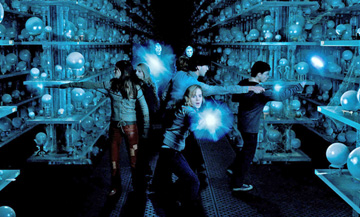
Harry Potter and the Order of the Phoenix

The realm of spectacle and sorcery at the heart of “Harry Potter and the Order of the Phoenix” is not the gentle and capricious place that moviegoers were enticed into admiring when this series first came to the cinema six years ago. Gone are the good-hearted and harmless touches of children’s fantasy, their light-weight and colorful textures replaced by shadows, dank exteriors, menace and threat, and an occasional blood splatter thrown in to emphasize the notion of evil being actively at work in the fabric of the story. We have always anticipated the world of Potter and his magical friends to get darker and more solemn, not just because the premise conflicts require it to, but also because it is of the nature of kids to look at their settings in more serious a light when childhood daydreaming is replaced by the reality of adolescence.

Posted July 15, 2007
ON DVD
Children of Men

Alfonso Cuarón’s “Children of Men” is the anti-thesis of the modern Hollywood movie dystopia, an endeavor in which the vision of a condemned human civilization contains no gloss, depends on nothing proverbial, and insists on taking paths so seldom traveled that we often wonder if it knows just how dangerous or challenging the unpaved roads can be. Its greatest safety net may lie in the fact that the director has never been of the traditional flavor anyway – sly and unusual, Cuarón knows it takes a fully analytical slant for the material to work, and he doesn’t bat an eyelash. The very soul of the film scoffs at the prospect of being conventional or formulaic.

Posted July 9, 2007
IN THEATERS
28 Weeks Later

The zombie movie is a silly but stimulating beast, a popular sub-genre in horror that has survived, evolved and outlasted many of its counterparts for as long as movies of this nature have been popular on the big screen. Those who acknowledge it as such would also be more than happy to stress the fact that the cinematic undead developed a lot more potential after they were discovered by George A. Romero, the director who, in 1968, took a nearly childish premise and used it as a platform for things no one would have ever expected of the material: that is, thought-provoking (and relevant) social and political commentary.

Posted July 1, 2007

IN THEATERS
Pirates of the Caribbean: At World's End

There is a scene early on in “Pirates of the Caribbean: At World’s End” when Captain Jack Sparrow (Johnny Depp) finds himself barking orders at a crew of insubordinate misfits that, for the lack of a better word, are also physical replicas of himself. Because he is the isolated subject of this multi-faceted sequence in which one Sparrow argues with hundreds of others, we half expect Depp to be liberated enough by the groundwork to be able to leap at the material with zeal and spirit. But the enthusiasm never emerges from his work; nor, for that matter, does anything resembling general interest or patience.

Posted July 1, 2007

ON DVD
The Fountain

The director who undertakes ventures that are about more than conventional entertainment value is the director who goes on to make a movie like “The Fountain,” in which message and concept are bound by touches of experiment in a way that lends great potential to the way a story can move, excite and intrigue us on more than just a surface level. The very existence of the movie is a refreshing notion, a manner made all the more exhilarating by the sheer gustiness of its thrust, and its ability to turn its own nose up at the idea of attracting a crowd interested only in traditional thrills.

Posted July 1, 2007
ON DVD
Hannibal Rising

If not for the fact that “Hannibal Rising” acquires a performance of great intensity and determination from newcomer Gaspard Ulliel in the title role, its only relevance would be as a topic of discussion in college film classes where the day’s lesson is about being conceited and overzealous with a screenplay. The movie is a mess of monstrous proportions, labored by all estimations from the narrative perspective, and driven by a certain smugness that demands the movie’s viewers to blindly accept any and all plot devices it throws at them, no matter how obvious and convenient they may be. To call the film obvious and manipulative in its conviction would not accurately sum up its most specific dilemmas, either; the screenplay displays such a lack of skill to its subject that it entirely skirts important issues, submitting to explanations that sidestep detail in favor of locating the most simplistic and expedient answers possible for the material. Hindsight, it turns out, is bad news when you’re a cannibal trapped in a Hollywood script.

Posted July 1, 2007


SECTIONS: THE LATEST | ARTICLES | REVIEWS | BLOG | FORUM | LINKS | CONTACT
All published materials contained herein are owned by their respective authors and cannot be reprinted, either in their entirety or in selection, without the expressed written consent of the writers.

© 2007 Cinemaphile.org.